The mountains look close on the map. Then you leave the motorway, the road begins to climb, and the light turns a flat grey. Somewhere above you the snow line is waiting, and the hire car in front has just braked in the middle of a hairpin to fit chains it has never taken out of the box. Most winter alpine trips don't go wrong on the slopes. They go wrong in the last forty kilometres of driving, or in the hour before departure when nobody checked whether the pass was open.
None of this is complicated. It just needs doing in the right order, and preferably a week before you leave rather than at a foggy layby at four in the afternoon. Here is what actually matters.
Winter tyres are the single decision that shapes the rest of the trip. Not because a mountain road is a rally stage, but because snow, slush and cold tarmac are ordinary conditions up there for four months of the year.
A proper winter tyre carries the three-peak mountain snowflake marking on the sidewall. All-season tyres with the same marking are legal in many alpine countries and are a reasonable compromise if you drive in the mountains occasionally and know you'll be sensible. They are still a compromise: on a genuinely snowy climb, the difference in grip is noticeable.
Check tread depth before you pack anything else. Austria expects at least 4 mm on winter tyres in wintry conditions. Italy's legal minimum is the general 1.6 mm, which nobody who has driven a cold hairpin at dusk believes is enough. Four millimetres is a sane working target wherever you're going. Check pressures cold, including the spare, and remember that a loaded car with a roof box wants a little more air than the door sticker suggests for two people.
Rules differ by country — Italy's winter equipment obligations run roughly from mid-November to mid-April on many routes, Austria applies winter tyre rules in wintry conditions between November and April, and France requires chains on signposted snow routes. Dates and local variations change, so confirm the current position for your route with your hotel or the relevant national motoring authority before you travel.
Chains are not a decoration to satisfy a police check. They are what gets you up the last kilometre to a car park when the plough hasn't been through. Two things ruin the experience: buying the wrong size, and fitting them for the first time in the dark.
Look up the exact tyre size in your car's manual or on the sidewall, buy chains matched to it, and check that your car can take chains at all — some models have limited clearance around the front wheels and need alternatives. Then, at home, in daylight, on dry ground, fit one pair once. It takes twenty minutes the first time and five the second.
Drive in daylight. It sounds obvious and it is the advice most often ignored, because leaving after work on Friday seems efficient. Arriving at a mountain village in the dark, in falling snow, with tired eyes and an unfamiliar car, is where small mistakes get expensive.
If you can, cross the high passes and tunnels before mid-afternoon. Saturday is changeover day in many resorts, which means traffic both ways and full car parks; Sunday evening brings a second wave heading home. A Tuesday-to-Tuesday trip is calmer and often easier on the mood.
Build one flexible day into your plan. When a front moves in, the best choice is usually to wait six hours in a town with a decent café rather than to push through a squall to keep a schedule nobody will remember.
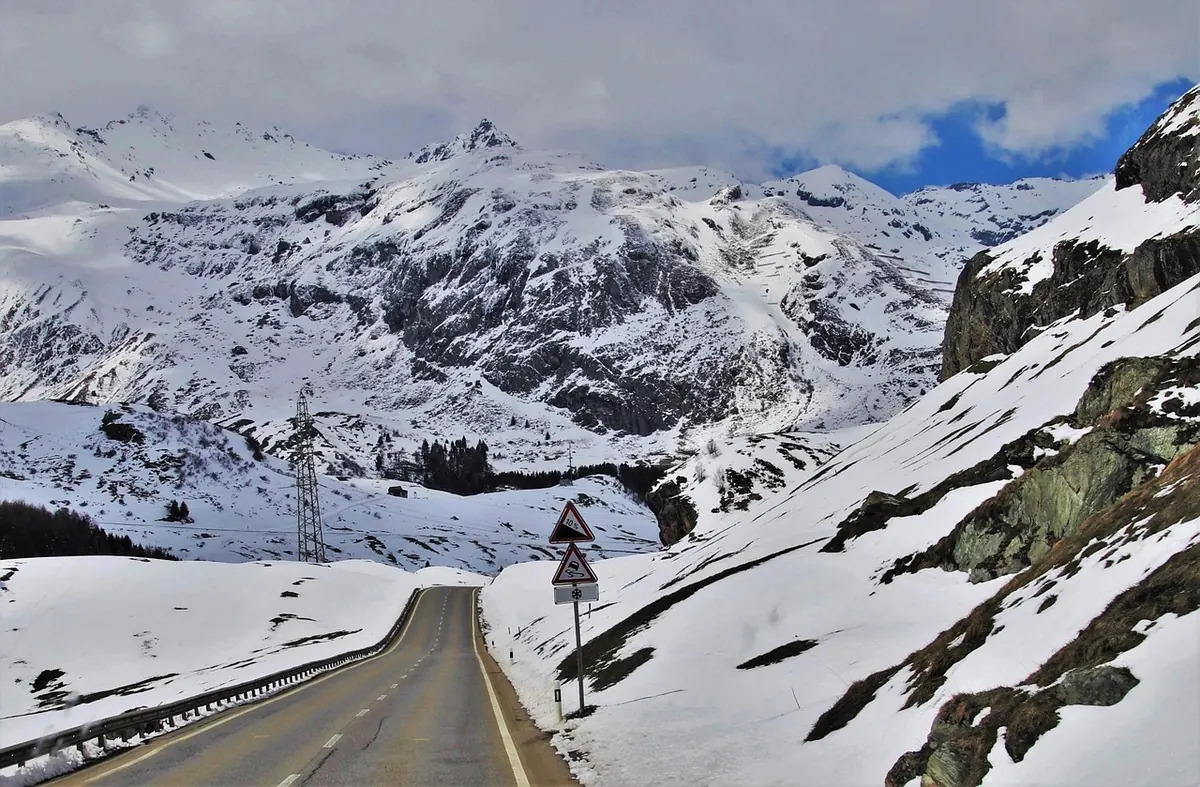
Alpine roads close. High passes shut for the season, usually from late autumn to late spring, and even year-round routes get closed for a few hours during heavy snowfall or avalanche control. Tunnels close overnight or for maintenance, sometimes with little notice.
Before each driving day, check the forecast, the pass status and the tunnel situation on the relevant road authority or traffic service. Your accommodation almost always knows more than the app does — a quick question at breakfast has saved plenty of pointless detours. Carry a paper map or downloaded offline maps, because signal in valleys is unreliable exactly when you need it.
Sort out the paperwork and payments in advance: Austria and Switzerland require motorway vignettes, France and Italy charge tolls on the main Alpine routes, and a card that works at an unmanned barrier removes a lot of stress. Keep some coins handy anyway.
Ask three questions of any accommodation: is the parking covered, is it cleared when it snows, and is the access road treated? A space that is "available" can mean a sloping gravel patch behind the building that requires chains at seven in the morning.
In resort, covered garages are worth the cost in a heavy-snow week; you will spend far less time scraping and digging. Open car parks fill early on weekends, and some require chains simply to reach the entrance ramp. Don't leave the car on a road marked for snow clearing, and note where you left it — a ploughed car park looks entirely different under thirty centimetres of fresh snow.
You will not use most of this on most trips. You will be very glad of it on one.
Give the car itself an hour of attention too. A weak battery that starts fine in a mild city will fail at minus ten, so have it tested if it is more than a few years old. Check coolant strength, lights and brakes. Fill up before you climb rather than hunting for a mountain station, and keep the tank above half. Diesel drivers coming from milder lowland regions should fill up in the mountains, where winter-grade fuel is sold. Electric drivers should plan charging stops with cold-weather range loss in mind and preheat the cabin while plugged in.
Ten minutes, once, saves an hour of roadside improvisation. Check the forecast and the pass status one last time. Put the chains, shovel, scraper and gloves on top of the luggage rather than underneath it. Charge everything. Set the alarm half an hour earlier than feels necessary, and accept that the first twenty kilometres will be slow.
That is the whole trick of a winter drive to the Alps: decide the difficult things in advance, at home, with a cup of coffee, so that on the day you only have to drive carefully and enjoy the view coming up through the windscreen.
Photo: pasja1000 / Pixabay