Every winter group has a split in it. One person is up before the lifts open, checking the snow report. Another would rather walk for an hour and then sit somewhere with a view and a hot drink. Someone else has a knee that complains, and one member of the party has never clipped into bindings and has no plans to start. Alpine resorts are unusually good at handling this. The valley floor, the mid-stations and the thermal baths do not require a ski pass or any particular level of fitness, and a well-planned day can have everyone eating lunch at the same table by one o'clock.
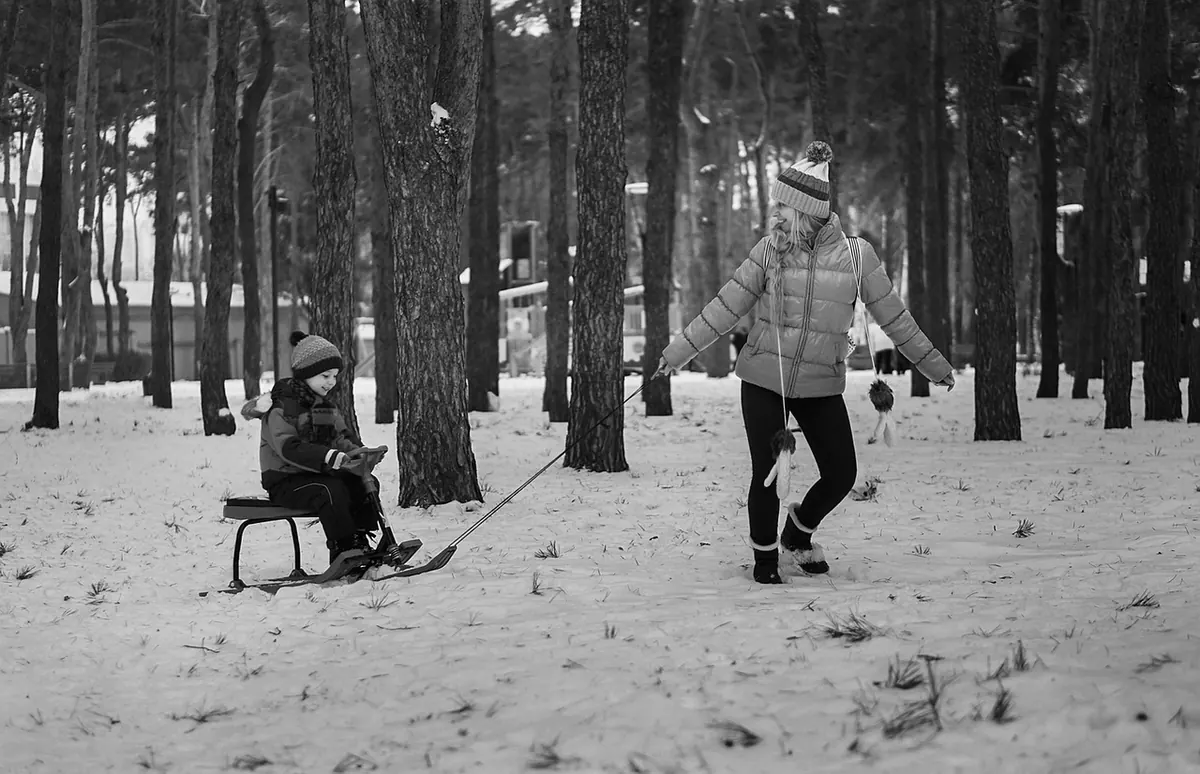
A toboggan run asks almost nothing of you. In Austria they are called Rodelbahnen, in Italy slittino, in France piste de luge, and most resorts keep at least one groomed track that a beginner can handle. Rental huts at the base station hand over a wooden sled for the day, and you walk up the same track you will later slide down.
The classic setup suits mixed groups: two kilometres of wide, gently banked run, a hut at the top serving soup, and a walk-up that takes anywhere from twenty minutes to an hour depending on how often you stop. Several Austrian resorts floodlight their runs once a week so you can sled after dark, which tends to become the story everyone retells.
A few things make the difference between a great afternoon and a sore one:
For the skiers in the group, a sledding afternoon is an easy half-day off. For anyone nervous about the mountain, it is a way to be on it without committing to anything.
Snowshoeing has a reputation for being more athletic than it is. On a marked winter trail with a modest climb, it is a walk at a slow pace, and the shoes do the work of keeping you on top of the snow.
The trick with mixed groups is to plan the shortest, flattest option and let the stronger walkers add a loop. Many resorts mark winter footpaths — Winterwanderwege in Austria, percorsi invernali in Italy — that are rolled or packed and can be done in ordinary boots. Snowshoes open up the softer trails beside them. A two-hour outing with a hut stop in the middle is plenty for most parties, and it leaves the afternoon free.
Off-trail snowshoeing crosses avalanche terrain, and the fact that you are walking rather than skiing makes no difference to the risk. If nobody in the group has avalanche training, stay on marked trails or hire a mountain guide for the day. Rental shops will supply shoes and poles; ask them which routes are currently recommended and which are closed.
Small kit details make the day better: gaiters keep snow out of your boots, sunglasses are essential on bright days, and a flask of something hot earns you friends. Bring water even though it is cold — people underestimate how much they sweat under a shell.
Thermal water is one of the Alps' oldest attractions, and it does not care what your ski level is. Towns such as Bormio, Merano, Leukerbad and Bad Gastein are built around it, with multi-hour passes that cover pools, steam rooms and relaxation areas. Grandparents, teenagers and the person with the bad knee can all disappear into the same building for three hours and come out cheerful.
Etiquette varies more than you might expect. Austrian, German and Swiss sauna areas are often textile-free, while Italian spas generally expect swimwear throughout. Some places run family hours and quiet hours, and age rules for children differ from one establishment to the next. Check the house rules online before you book, and tell the group what to expect so nobody is caught out at the changing room door.
One sensible note: if anyone in the party is pregnant or has heart, circulation or blood-pressure conditions, they should ask a doctor before using hot pools and saunas, and keep sessions short.
Cable cars, funiculars, rack railways and postbuses turn a mountain into a sightseeing trip. You ride up, walk ten minutes to a viewpoint or a hut, eat lunch, and ride back down. Resorts publish pedestrian fares for exactly this, and many mid-stations have a terrace, a restaurant and a short circular path that takes twenty minutes in boots.
This is the option for the person who wants the view without the effort, and it is also the best bad-weather plan. Two practical habits: check the last descent time before you go up, because in winter it can be as early as mid-afternoon, and check whether strong wind has closed the lift. A mountain railway that runs through the winter — the kind found in Switzerland and parts of Austria — is a day out in itself, with villages and tunnels instead of a single ride.
Groups tend to fail at coordination, not at activities. A simple structure keeps everyone together without forcing anyone into the same thing.
None of this requires the group to be evenly matched. It requires a plan that gives everyone a good afternoon and a reason to turn up at dinner.
Photo: Sunriseforever / Pixabay